What Happens Before Mastering?
Inside the MARROW production process — the recording, editing and mixing decisions that have to happen before I even think about mastering.

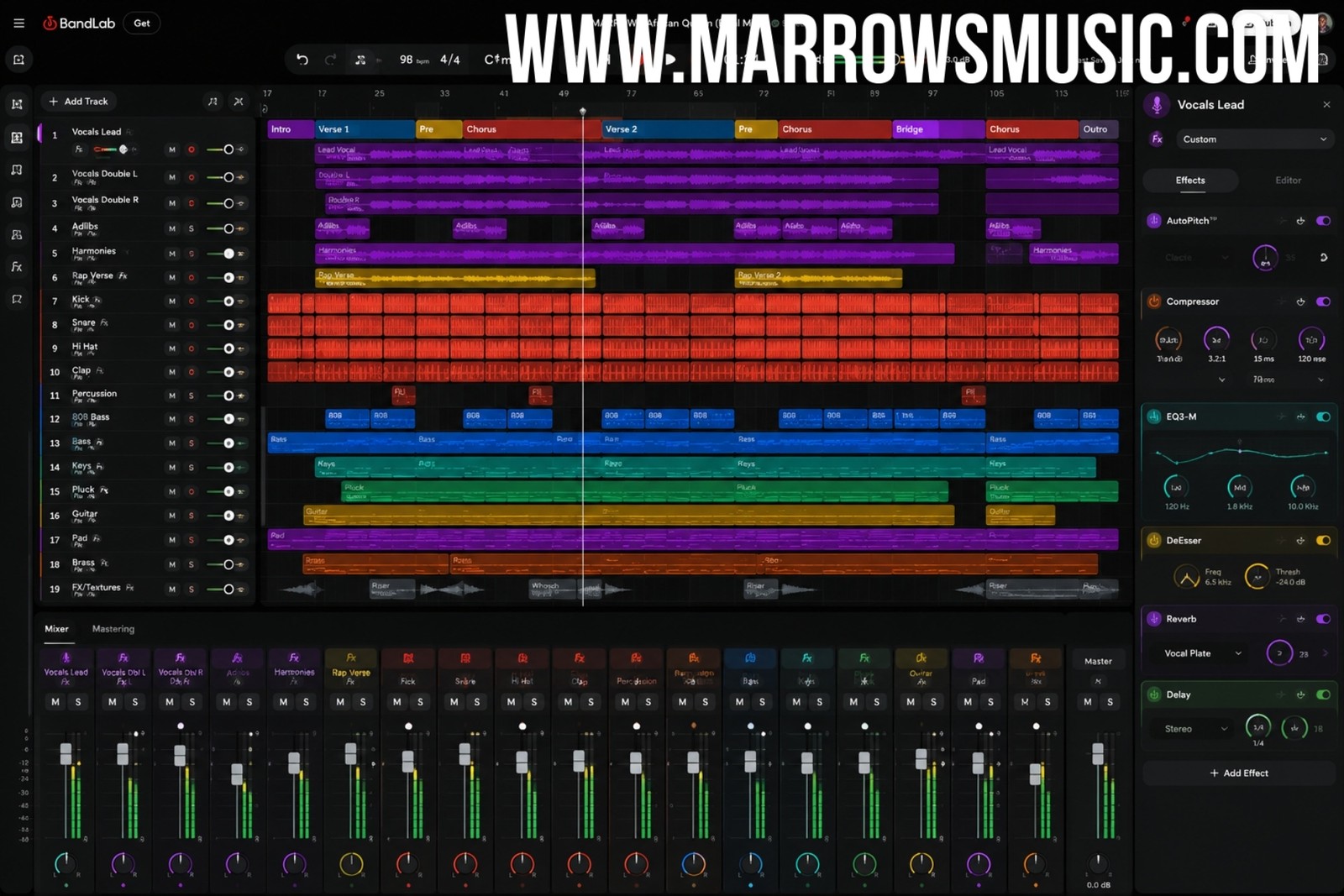
When people hear a finished song, they hear one clean piece of music. What they don’t necessarily hear are all the individual layers underneath it — lead vocals, doubles, harmonies, ad-libs, drums, bass, instruments, effects and automation all working together.
A busy recording session can look a little crazy on screen. But for me, every track should have a purpose. The goal isn’t to make the project look complicated. The goal is to make all those separate pieces eventually feel like one record.
It starts with the recording
The vocal is one of the most important parts of my process. I’ll record the main vocal and, depending on the song, build around it with doubles, backing vocals, harmonies and ad-libs. Then comes editing: choosing the strongest takes, tightening timing where needed, cleaning unwanted noise and getting the recordings ready to mix.
Organising the session
Once the recordings are ready, the project starts growing quickly. Keeping vocals, drums, bass, instruments and effects organised makes a huge difference. I want to be able to look at the session and immediately understand what I’m hearing and where it belongs.
Cleaning the frequencies
EQ is where I start creating space. Different sounds can fight for the same frequencies, which can make a mix muddy, harsh or crowded. Sometimes the best move isn’t adding more — it’s removing what isn’t needed so the vocal, bass, drums and instruments can breathe.
Compression and vocal control
A vocal naturally changes in level from word to word. Compression helps me control those differences and keep the performance sitting consistently inside the instrumental. I also use buses where appropriate so related vocal layers can be processed together and feel more connected.
Pitch correction as a tool
Pitch correction can be part of the chain, but I don’t see it as a replacement for getting a good performance. The starting point is still the recording. The stronger the take is at the microphone, the less I have to ask the processing to do afterwards.
Creating space with effects
Reverb and delay help create depth, width and movement, but they have to be controlled. Too much can push a vocal backwards or clutter the mix. Sometimes I’ll automate an effect so it only appears on a particular word, phrase or transition.
Automation brings the mix to life
Automation lets the record change as it develops. A vocal can rise slightly in the chorus, an instrument can move back when the lead enters, or a delay can appear at the end of one line. Those small movements can make the whole song feel more alive.
The final mix-bus check
Eventually I stop listening to individual tracks and listen to the whole record. Are the vocals clear? Does the kick work with the bass? Is anything harsh? Does the chorus feel bigger than the verse? Is there enough headroom? If something still feels wrong, I fix it in the mix.
Mastering isn’t supposed to rescue a bad mix. By the time I reach mastering, the song should already sound like the record I intended to make.
Then — and only then — mastering
Mastering is the final polish: overall tonal balance, dynamics, loudness and playback consistency so the finished track translates across headphones, speakers, cars and streaming platforms. If I’m still fighting an individual vocal or the bass at that stage, I know I need to go back to the mix.
That’s why the screen can look so busy before mastering. Every waveform, channel, bus, effect and automation move represents another decision. You start with separate recordings. You clean them, balance them, shape them and give them space — until they stop sounding like tracks on a screen and start sounding like a record.
Behind the music. Behind the mix.
Always learning, always refining the process — MARROW.